publications
2026
- Describe-Then-Act: Proactive Agent Steering via Distilled Language-Action World ModelsMassimiliano Pappa, Luca Romani, Valentino Sacco, Alessio Palma, and 4 more authorsIn European Conference on Computer Vision (ECCV), 2026
Deploying safety-critical agents requires anticipating the consequences of actions before they are executed. Describe-Then-Act introduces DILLO, a fast steering layer that shifts proactive agent control from visual simulation to semantic outcome prediction via distilled language-action world models. Experiments on MetaWorld and LIBERO show improved policy steering with substantially reduced latency.
@inproceedings{pappa2026describethenact, title = {Describe-Then-Act: Proactive Agent Steering via Distilled Language-Action World Models}, author = {Pappa, Massimiliano and Romani, Luca and Sacco, Valentino and Palma, Alessio and Lathuili\`ere, St\'ephane and Galasso, Fabio and Alameda-Pineda, Xavier and Spinelli, Indro}, booktitle = {European Conference on Computer Vision (ECCV)}, year = {2026}, eprint = {2603.23149}, archiveprefix = {arXiv}, primaryclass = {cs.AI}, url = {https://arxiv.org/abs/2603.23149}, } - Robots Ask the Way: Communication-Enabled Social NavigationValentino Sacco, Luca Scofano, Indro Spinelli, and Fabio GalassoIn IEEE/RSJ International Conference on Intelligent Robots and Systems (IROS), 2026
Communication-enabled Social Navigation (CommNav) introduces robotic agents that actively seek assistance from residents to locate target individuals. The work extends Habitat 3.0 with communication-enabled multi-human environments and shows that explicit communication improves multi-person navigation performance while remaining robust to natural, colloquial human language.
@inproceedings{sacco2026robotsasktheway,
  title = {Robots Ask the Way: Communication-Enabled Social Navigation},
  author = {Sacco, Valentino and Scofano, Luca and Spinelli, Indro and Galasso, Fabio},
  booktitle = {IEEE/RSJ International Conference on Intelligent Robots and Systems (IROS)},
  year = {2026},
  eprint = {2607.01044},
  archiveprefix = {arXiv},
  primaryclass = {cs.RO},
  url = {https://arxiv.org/abs/2607.01044},
}
2025
-
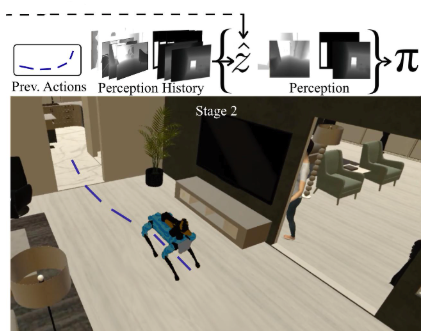 Following the Human Thread in Social NavigationLuca Scofano*, Alessio Sampieri*, Tommaso Campari*, Valentino Sacco*, and 3 more authors2025
The success of collaboration between humans and robots in shared environments relies on the robot’s real-time adaptation to human motion. Specifically, in Social Navigation, the agent should be close enough to assist but ready to back up to let the human move freely, avoiding collisions. Human trajectories emerge as crucial cues in Social Navigation, but they are partially observable from the robot’s egocentric view and computationally complex to process. We present the first Social Dynamics Adaptation model (SDA) based on the robot’s state-action history to infer the social dynamics. We propose a two-stage Reinforcement Learning framework: the first learns to encode the human trajectories into social dynamics and learns a motion policy conditioned on this encoded information, the current status, and the previous action. Here, the trajectories are fully visible, i.e., assumed as privileged information. In the second stage, the trained policy operates without direct access to trajectories. Instead, the model infers the social dynamics solely from the history of previous actions and statuses in real-time. Tested on the novel Habitat 3.0 platform, SDA sets a novel state-of-the-art (SotA) performance in finding and following humans.
@misc{scofano2025followinghumanthreadsocial,
  title = {Following the Human Thread in Social Navigation},
  author = {Scofano, Luca and Sampieri, Alessio and Campari, Tommaso and Sacco, Valentino and Spinelli, Indro and Ballan, Lamberto and Galasso, Fabio},
  year = {2025},
  eprint = {2404.11327},
  archiveprefix = {arXiv},
  primaryclass = {cs.RO},
  url = {https://arxiv.org/abs/2404.11327},
}